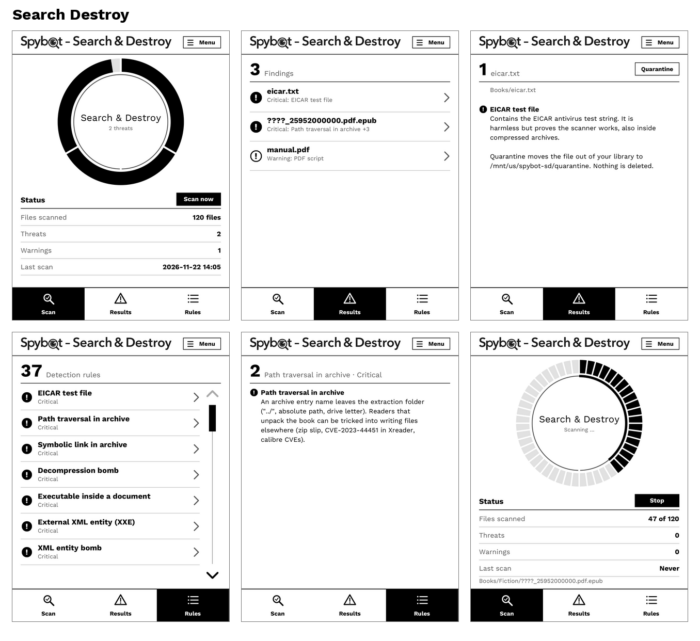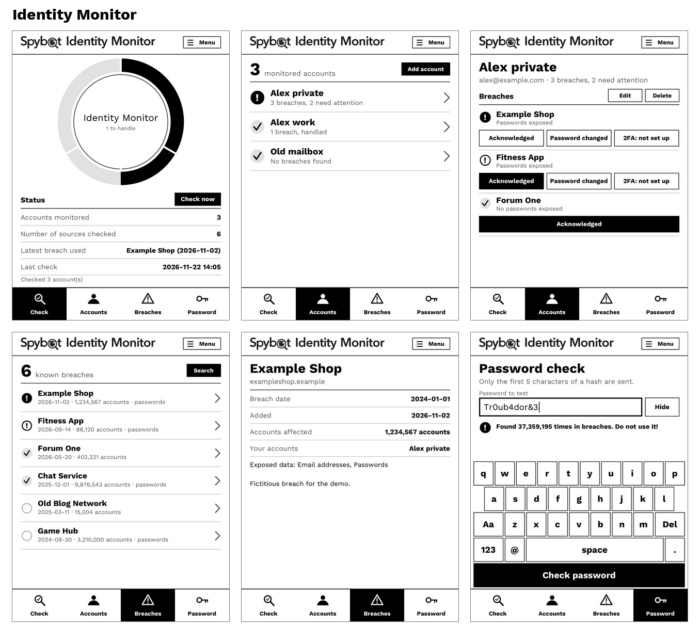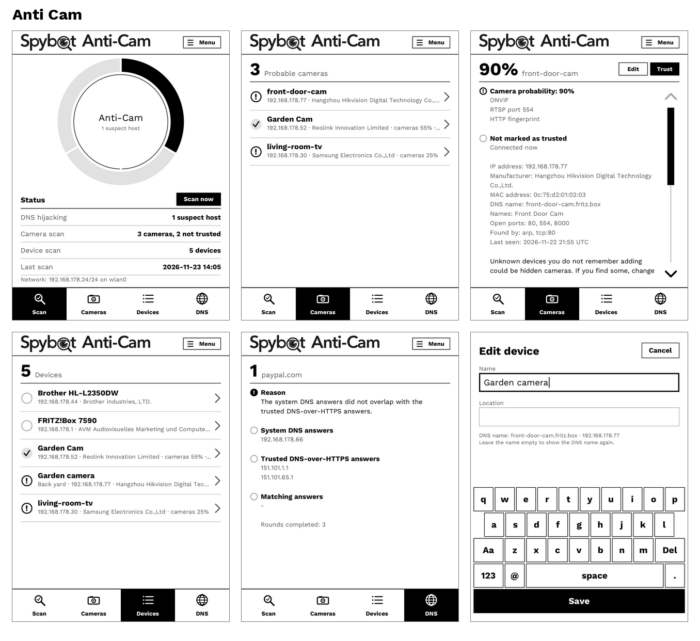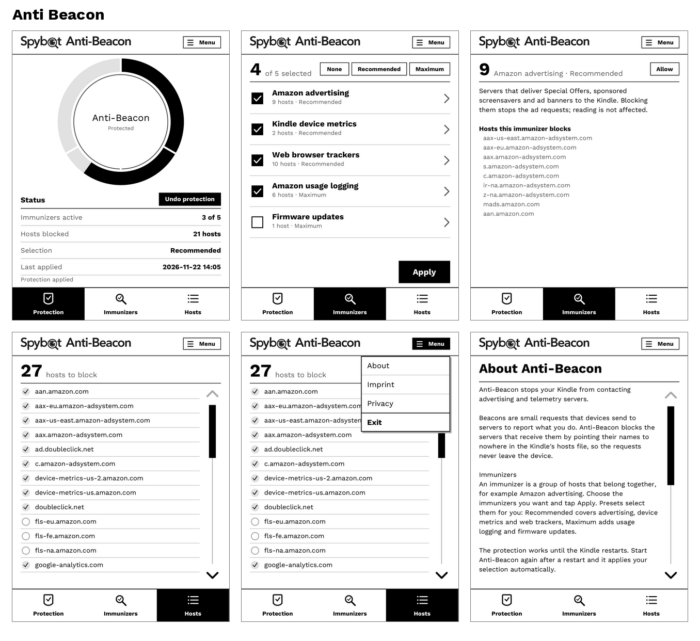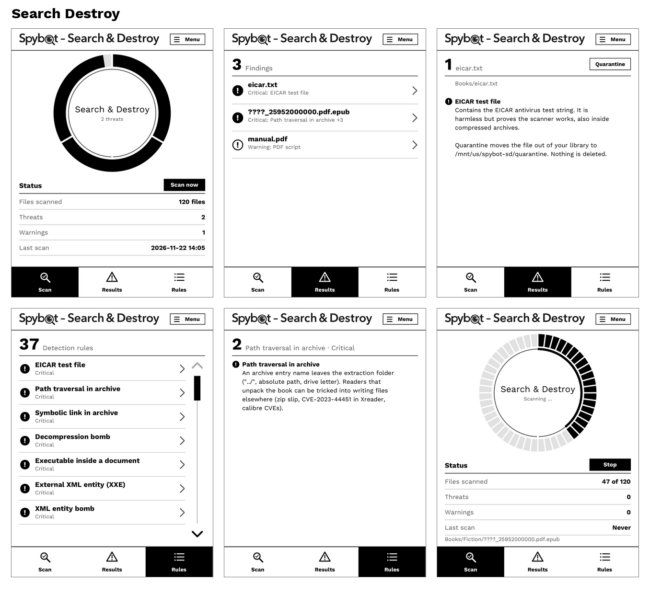

Four experimental Kindle ports, one weekend, and a closer look at what “up to date” means for a connected device. By Patrick, the Spybot founder.
My Kindle Oasis normally has a straightforward job: displaying books.
It is also running the latest firmware Amazon currently offers for its model, and that firmware is within the range covered by the publicly documented SpiderCat jailbreak.
As of 23 November 2026, Amazon lists firmware 5.18.2.1.1 for the Kindle Oasis 10th generation. SpiderCat demonstrates how a specially crafted ebook can execute code on affected devices. Its documentation says the entry point was patched in firmware 5.19.6 and later, but that newer branch is currently not available for this Oasis (Amazon firmware list, SpiderCat project).
Keeping devices updated remains good advice. It cannot resolve a particular vulnerability when the necessary fix is unavailable for that model. That made my e-reader an interesting subject for a weekend experiment. Drawing on our existing applications, I ported experimental versions of Spybot – Search & Destroy, Anti-Beacon, Identity Monitor, and Anti-Cam to it.
I wanted to explore what familiar security and privacy tools could do on a device we usually think of simply as a reader.
Four tools, four questions
Spybot Search & Destroy checks supported e-book files for suspicious structures and indicators associated with potentially malicious content. A suspicious feature is not automatically a working exploit, and a clean result cannot guarantee that a book is safe. Detection scope and test results matter.
Spybot Anti-Beacon applies host-based blocking to selected advertising and telemetry destinations. It explores how much control an owner can exercise over particular connections. A host list has limits and cannot establish that all unwanted communication has stopped.
Spybot Identity Monitor brings account-breach checking and follow-up tracking to the e-reader. This one simply explores making an existing privacy tool usable on another kind of screen.
Spybot Anti-Cam examines reachable devices on the local network for camera-related indicators and checks for DNS discrepancies that may deserve investigation. It cannot establish that a room is definitively free of cameras. Offline cameras, isolated devices, and equipment on other networks may be invisible to it. It might help for the random AirBnb camera on the same WiFi as guests though.
Why do this on a Kindle?
For several of these tasks, my phone is more convenient. Most Kindle owners are unlikely to install experimental applications on a jailbroken reader.
But trying them on an e-reader makes a broader question tangible: which connected devices do we stop thinking about once they appear to work?
A device does not need to hold our most valuable files to deserve attention. If compromised, its network access can matter too. The consequences depend on the network and the protections around it. Separating less-trusted equipment from sensitive systems can reduce what a compromised device can reach. (NIST guidance on home and small-business IoT security)
The Kindle community’s work deserves credit here. SpiderCat supplies an existing example of why reader software warrants scrutiny. Our contribution is this experiment with Spybot applications, rather than a claim to have discovered that vulnerability.
What this experiment establishes
The ports run on a jailbroken Kindle Oasis. Installing them requires a previously jailbroken device. They are experimental builds with limited testing, and this article is not a recommendation to modify a reader as a security measure.
The applications do not patch the underlying firmware vulnerability. Whether an ebook scanner detects a particular exploit is a separate question that needs a specific test; the existence of the port does not establish that result.
The weekend also had a substantial head start: years of work on the original tools. It produced working prototypes and questions worth investigating further. Establishing coverage, reliability, and compatibility takes more testing.
Why this fits Spybot
We regard privacy as an individual civil right, and protecting it takes priority. We do not track our users. We also have no external investors. That independence gives us room to investigate questions whose value is not measured primarily in potential sales.
An e-reader is an unusual place to find Spybot. It is also a useful place to keep asking what owners should be able to understand and control.
Watch the demonstration and inspect the test details below. Join the discussion at the thread on our forums – we welcome challenges to the assumptions as much as suggestions for the applications.
Patrick, Team Spybot
| Device | Kindle Oasis (10th Generation) |
| Installed firmware | 5.18.2.1.1 (4821110015) |
| Application builds | Tested November 21st and 22nd, 2026. |
| Environment | SpiderCat from 01/09/26; Custom Dropbear SSH server version to automate password-less login for test environment tools. |
| E-book formats examined | ZIP-based (epub, kepub, cbz, zip), PDF, Palm/Kindle (mobi, azw, azw3, prc, pdb), DjVu (djvu, djv), RAR (cbr, rar). No DRM protected e-books were tested. |
| E-book tests | evil-epubs examples from Gertjan Franken, Tom Van Goethem, Wouter Joosen. javascript_execution, remote_communication, engine_identified, feature_access and uri_handles have been detected due to scripts or other active embedded content. Custom EICAR e-book and SpiderCat e-book have been tested. |
| False positives and misses | Small set of real books tested, no false positives. |
| Host blocking | Blocked are Kindle related hosts found through simple Internet searches – Amazon ads, Kindle telemetry, Protocols, Firmware Updates. The app shows the list of host names. Hosts file is changed in memory, so a reboot will restore the official hosts file, no permanent changes applied. |
| Network checks | Simple IP range scan; DNS name resolution; port scanning; DNS hijack protection by comparing results of different DNS servers. |
| Privacy/data flow | Identity Monitor sends data to our own breaches server: email addresses to check, and k-Anonymity protected password hashes that do not allow the server or anything between to read the password that is tested. Anti-Cam sends probes to local devices without any personal data. Network devices might only notice that the device is probing. |
| Availability | Demonstration only so far, looking into kpm. |
| Support | None, but discussion welcome. |